


VSME reporting for pragmatic ESG structuring.
We support SMEs in structuring ESG data and reporting using the VSME standard, aligned with business reality and value creation.
Structure your ESG strategy without the complexity of full CSRD compliance.
Your clients, banks and partners are already asking for ESG data.
The question is not if you should structure it, but how you do it efficiently and credibly.
VSME gives SMEs a clear and proportionate European framework to organise their ESG data, answer stakeholder requests and strengthen their market position without the complexity of full CSRD reporting. It turns scattered information into structured insight that supports tenders, financing discussions and long term strategy.


What is the VSME?
The VSME Standard (Voluntary Sustainability Reporting Standard for non-listed SMEs) was developed by EFRAG at the request of the European Commission.
It addresses the growing need for ESG transparency among small and medium-sized enterprises not subject to the CSRD, by providing a structured and accessible reporting framework.
Its principles:
Voluntary framework
More accessible vs CSRD
Simplification and cost reduction
Open to all companies (not subject to CSRD)
VSME reporting enables small and medium enterprises to structure and communicate their ESG initiatives.
Is your company concerned ?
You are concerned if:
Your are not subject to CSRD reporting
You are a company with less than 1000 employees
You want to anticipate regulatory developments without implementing a full CSRD framework.
You need a structured ESG report to support tenders, financing requests or investor discussions.
VSME is designed precisely for SMEs that need to respond to growing ESG expectations in a proportionate, practical and business oriented way.

VSME Medals to structure your ESG journey
Whether your ESG journey is just beginning or already well structured, the VSME Medals offer a clear and credible way to recognize your level of commitment.
Developed by SMT Lab and supported by the SMT Collective, the Medals are based on the VSME Standard (the Voluntary Sustainability Reporting Standard for non-listed SMEs) created by EFRAG at the request of the European Commission.
While EFRAG designed the reporting framework, it is the SMT Collective that transformed it into a practical recognition system to assess and showcase ESG maturity.
The four levels, Bronze, Silver, Gold, and Platinum, reflect how advanced your ESG practices are, from first data collection to full strategic integration.
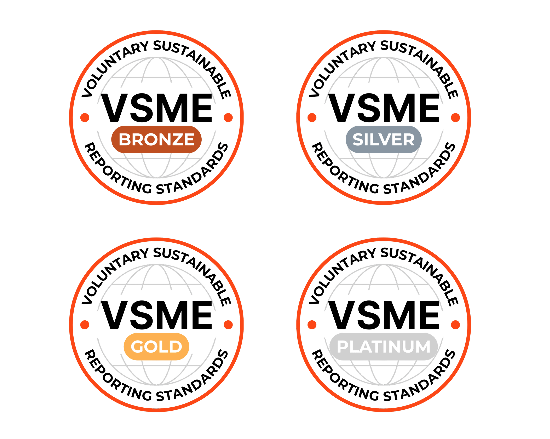
By obtaining a VSME Medal, your company can position itself within a European ESG framework, demonstrate transparency and credibility to stakeholders and prepare effectively for future regulatory requirements.As an official partner of the VSME Medals, ESGlogic supports companies throughout the process from data collection to audit preparation to help them obtain their medal.
Discover the full initiative on the official website.
Our Structured Approach
-

Phase 1: Simplify your ESG data collection
• ESG data collection becomes structured and effortless
• Centralisation of key environmental, social and governance indicators
• Clear and consistent data from the start
Objective: collecting ESG data becomes effortless. Our digital tool centralizes key environmental, social, and governance indicators, ensuring clarity and consistency from the start.
-

Phase 2: Build your VSME compliant foundation
• Delivery of a VSME aligned report (basic or comprehensive)
• Foundation for your ESG strategy
• Link between data and concrete actions
• Integration of CO2 measurement, transition planning and continuous improvement
Objective: turn your ESG data into a VSME aligned foundation that drives concrete action and continuous improvement.
-

Phase 3: Integrate ESG into your broader strategy
• Move beyond reporting
• Aim for a VSME Medal
• Strengthen transparency and performance
• Turn ESG data into strategic insight
Objective: transform ESG data into strategic insight that strengthens transparency, boosts performance, and supports sustainable growth.
The advantages for your company ?
VSME reporting allows you to:
Strengthen your competitive positioning by meeting client and partner ESG expectations and increasing your chances in public and private tenders.
Improve access to financing through better eligibility for grants, subsidies and preferential interest rates linked to ESG performance.
Stay ahead of regulations by aligning early with key ESG indicators and reducing compliance risks.
Increase resilience by anticipating market shifts, transition risks and evolving stakeholder demands.


Why choose ESGlogic ?
Strong EU regulatory expertise (CBAM, CSRD, VSME, etc.)
Close relation with VSME Medals
One stop shop combining regulatory expertise, practical tools and sector insight
Experience with SMEs and larger groups
Structured methodology to implement the VSME framework step by step
We go beyond compliance and turn ESG into a strategic lever
Our role is to turn regulatory complexity into structured, strategic advantage.
Frequently Asked Questions
-
The CSRD (Corporate Sustainability Reporting Directive) is a mandatory European regulation requiring large and listed companies to publish detailed sustainability reports in line with the ESRS standards developed by EFRAG.
The VSME, on the other hand, is a voluntary standard designed for SMEs not subject to the CSRD. Developed by EFRAG, it provides a simplified and proportional framework to structure and communicate a company’s ESG approach.
-
Voluntary but structured, the VSME reference system enables companies not subject to CSRD to recognize each stage of their ESG commitment. Thanks to a system of medals, it offers clear, progressive recognition in line with stakeholder expectations.
-
Competitive advantage
Stand out through credible ESG action, stronger reputation, and employer appeal.Simplified partner relations
Respond efficiently to CSRD-related requests with a clear, recognized framework.Strategic foresight
Show your ability to anticipate market changes and lead the sustainability transition.Access to finance
Facilitate access to green funding and strengthen investor confidence. -
No, the double materiality assessment is not required under the VSME. It has been replaced by the “if applicable” principle, which is a conditional requirement embedded within each disclosure obligation.

Laurane Castermans
ESG Consultant - Head of CSRD/VSME
Let’s make you VSME Compliant!
Laurane will guide you!