

Carbon Footprint Is Just the Starting Point of Your Climate Strategy
More and more companies in Belgium and across Europe have started measuring their carbon footprint.
It’s becoming standard. Sometimes even expected.
But here’s the reality: a carbon footprint is step one of a climate strategy.
It gives you visibility on your emissions across your operations, suppliers and value chain.
But on its own, it doesn’t reduce anything. And that’s where many companies stop.
Why This Is Now a Business Topic, Not Just ESG
Climate is no longer just about sustainability. It directly impacts your business:
Market access → clients increasingly require ESG and carbon data
Competitive advantage → more mature companies stand out
Regulation → CSRD, value chain pressure, upcoming requirements
Costs → energy, inefficiencies, operational optimisation
Reputation → expectations from clients, investors and talent
What you do after your carbon footprint is what creates value.
The Carbon Footprint, A Necessary First Step
Your carbon footprint measures all your emissions (Scopes 1, 2 and 3).
It allows you to:
Understand where your impact comes from
Identify emission hotspots
Build a structured approach
Companies typically do it because:
Clients or partners are asking for data
They prepare for EcoVadis, B Corp or CSRD
They want to anticipate future regulations
They need a clear starting point
But without action, it remains a static report.
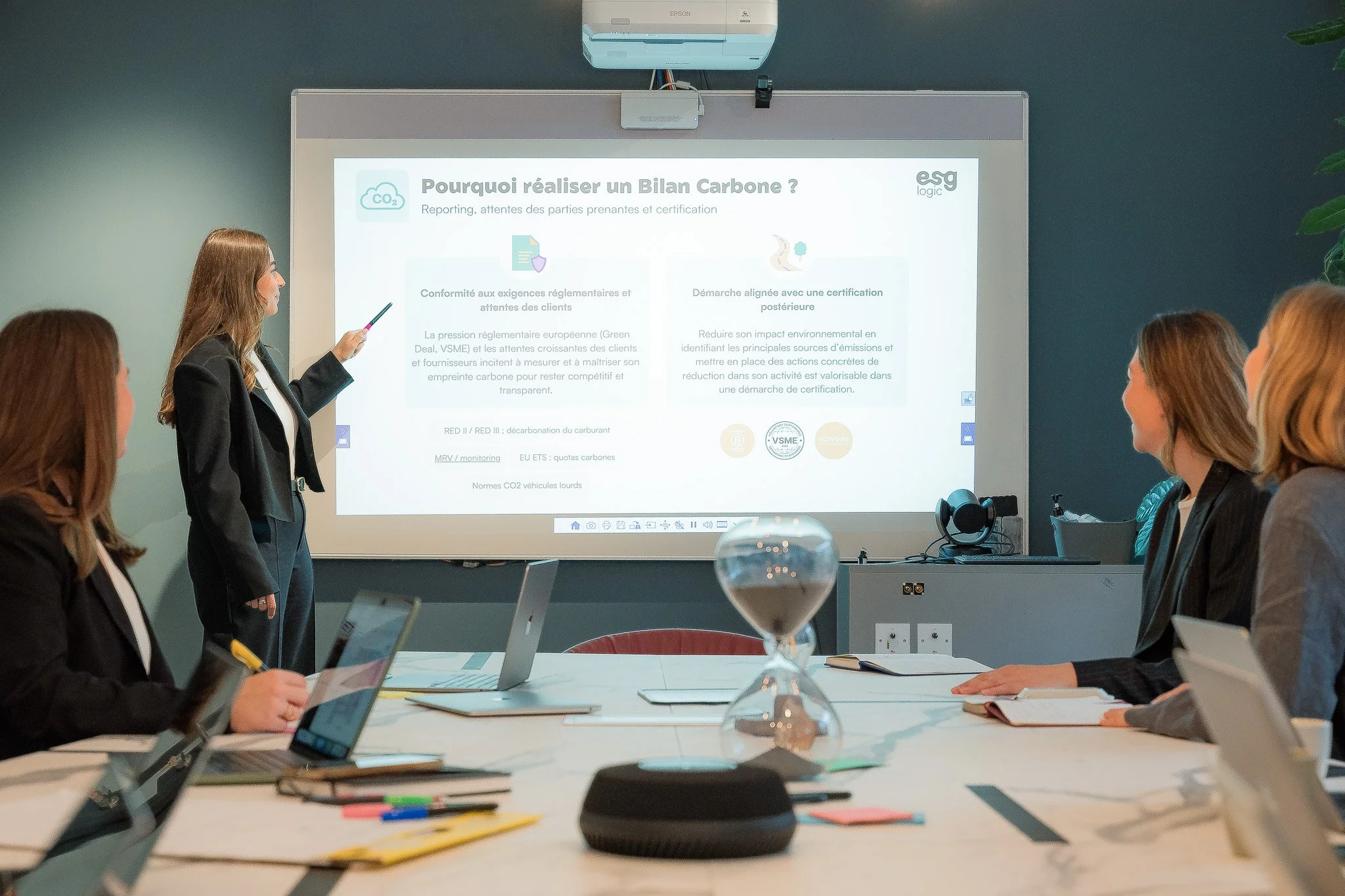
What Comes Next, Building A Real Climate Strategy
A climate strategy is a structured journey.
It connects:
Data
Decisions
Operations
Business outcomes
Here’s what it should include:
1. Turning Data Into Action, The Carbon Reduction Plan
This is where your carbon footprint starts creating value.
A reduction plan translates emissions into concrete actions:
Define clear reduction targets
Identify the most impactful levers
Quantify potential CO₂ reduction
Build a realistic roadmap
Expected outcomes:
Prioritised action plan
Measurable reduction targets
Clear implementation timeline
Monitoring dashboard
This is the shift from reporting to performance.
2- Structuring Your Ambition, Science-Based Targets (SBTi)
If you want credibility, you need alignment with science.
SBTi helps you:
Align with a 1.5°C trajectory
Structure a long-term roadmap
Engage your value chain
Why it matters:
It’s becoming a global standard
It strengthens investor trust
It prepares you for future regulations
It turns ambition into a credible commitment.
3. Understanding Your Exposure, Climate Risk Analysis
Climate is also a risk management topic.
Companies are exposed to:
Physical risks (floods, heatwaves, disruptions)
Transition risks (regulation, market changes, technology shifts)
But also opportunities:
Cost savings
New products and services
Market positioning
Ignoring these risks means losing control over your future.
4. Connecting Everything, The Climate Transition Plan
This is where strategy becomes business transformation.
A transition plan defines:
Your long-term trajectory
Your decarbonisation roadmap
Financial implications
Alignment with CSRD or VSME
It answers the question: How will your company remain competitive in a low-carbon economy?
This is what investors, regulators and clients increasingly expect.
One Pathway, Multiple Entry Points
What we’ve described here is a structured example, not a fixed model.
Every company starts from a different point:
Different level of maturity
Different sector constraints
Different regulatory exposure
Different business priorities
Which means your climate journey should not be linear or standardized.
5. Going Further, Advanced Climate Tools
5.1. CO₂ Performance Ladder (Construction and Transportation sector)
You want to increase your chances of winning public tenders?
The CO₂ Performance Ladder is a practical and recognised framework in the construction and transport sector.
It helps you:
Structure your carbon management
Reduce emissions in a continuous way
Communicate transparently
And most importantly it is often valued in public procurement processes, giving you a clear advantage over competitors.
5.2. Life Cycle Assessment (LCA)
You might be focusing on the wrong impact.
Your biggest environmental impact is often hidden in:
Materials
Production
Transport
End-of-life
LCA gives you a full lifecycle view to:
Identify hotspots
Improve product design
Meet client expectations
Why it matters now ?
In sectors like industry and construction, around 35% of tenders now require or strongly value LCA aligned with ISO 14040/44.
This trend is driven by:
Public procurement requirements
EU regulations (eco-design, product transparency)
Pressure from large companies
Without this data, you may simply not qualify.
5.3. CO₂ Calculator
You want to make better decisions, faster?
A CO₂ calculator allows you to:
Compare scenarios
Identify the most impactful options
Support decisions with data
For example:
Transport choices
Materials selection
Event formats
It also becomes a strong differentiation tool because you can anticipate all actions and emissions.
What This Means in Practice ?
A carbon footprint alone does not create value. What you do after does.
Without action:
You stay compliant, but not competitive
With a structured climate strategy:
You win tenders
You meet client expectations
You reduce costs
You strengthen your market position
Same data but completely different impact.
Want to turn your carbon footprint into a business advantage?
Why ESGlogic?
ESGlogic supports companies across the entire climate journey.
From Carbon footprint to:
Reduction plans
SBTi alignment
Climate Risk analysis
Transition plan
What makes the difference:
End-to-end expertise
Strong EU regulatory understanding
Operational and pragmatic approach
Focus on business impact
We build strategies that deliver results.
Frequently Asked Questions
-
No, it’s only the first step. You need reduction actions and a structured strategy.
-
A full climate strategy that can include Reduction Plans, SBTi targets, Risk Analysis, Transition Plan, CO2 Performance Ladder, Life Cycle Assessment and the CO2 Calculator
-
Yes, especially due to value chain pressure and increasing ESG expectations.
-
It depends on maturity, but initial steps can be structured within a few weeks.
-
A good starting point is mapping key suppliers, sending an ESG questionnaire, implementing a supplier code of conduct and analyzing the results.